
Pueblo County Criminal Courts
Pueblo County has three trial-court paths. Colorado District Court hears felony prosecutions and other higher-jurisdiction matters. County Court hears state-law misdemeanors and traffic cases. Both operate through Pueblo Combined Court in the Tenth Judicial District. The clerk at 501 N. Elizabeth Street keeps their court files and accepts record requests. Pueblo Municipal Court, at 200 S. Main Street, keeps City Charter and ordinance cases, along with some matters in which it has concurrent jurisdiction.
The charge, not merely the place of arrest, helps determine the court. A city arrest can lead to a municipal case, a state case in Combined Court, or both. The prosecutor may also amend or decline the initial booking charge. Search each plausible court before concluding that no case exists. The clerk's record, rather than the jail entry, is the sound source for what was filed and how the case ended.
Pueblo Court Jurisdiction Compared
The official Pueblo Municipal Court page shows the local city-court channel. Its role should not be confused with the Tenth Judicial District.
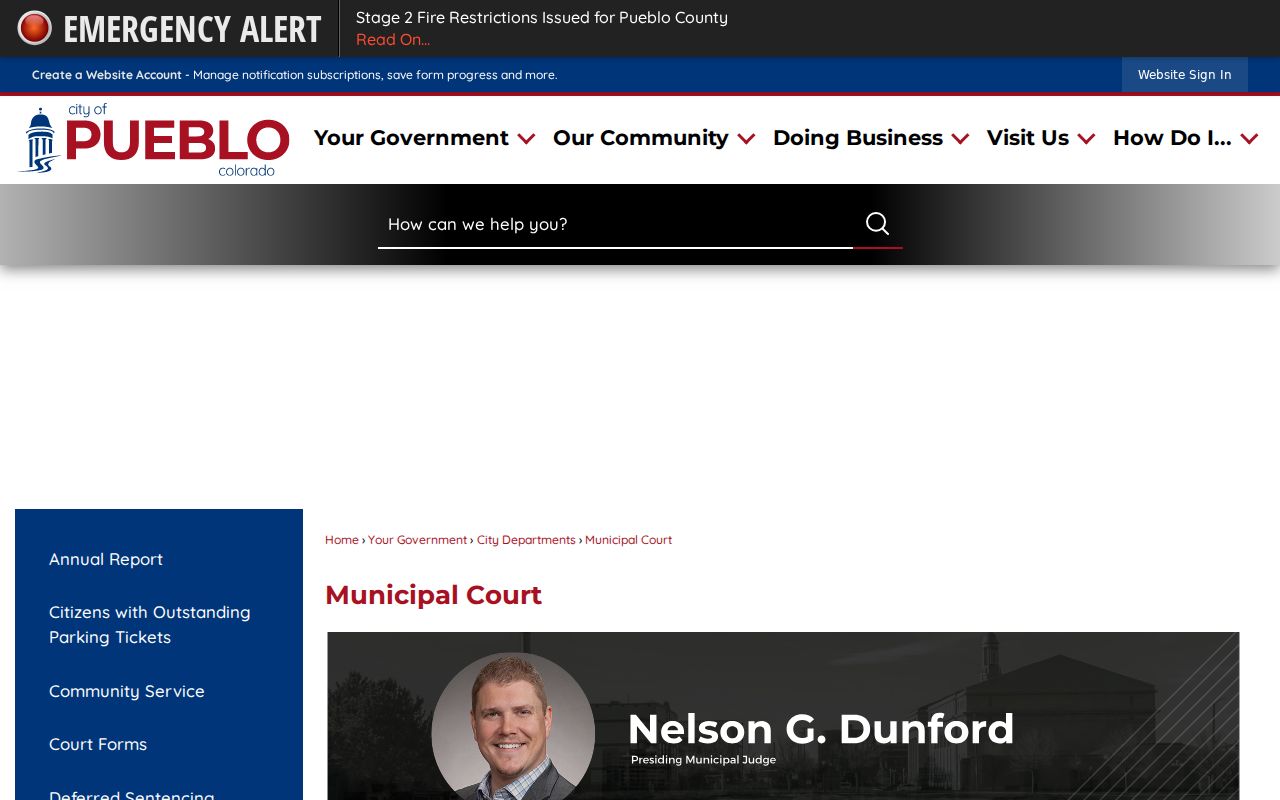
The image points to a court of record for city matters. State felonies and misdemeanors still belong at Pueblo Combined Court.
| Court | Main Pueblo case type | Record custodian |
|---|---|---|
| District Court | Felonies and higher-jurisdiction state matters | Pueblo Combined Court clerk |
| County Court | State misdemeanors and traffic cases | Pueblo Combined Court clerk |
| Municipal Court | City Charter and ordinance violations, plus some concurrent matters | Pueblo Municipal Court clerk |
How to Search Case Records
Begin with the free Colorado Judicial Branch public docket. It is a schedule and locator, not a full electronic file. At least one filter beyond date is required. A case number gives the cleanest route, but a careful party-name search can identify the court, division, hearing, and case number needed for a clerk request.
- Choose the Tenth Judicial District and Pueblo County, then select the appropriate courthouse or court type.
- Enter the segmented case number, or search an individual by first and last name.
- Use division and date controls to narrow similar names, then note the case number, court, and hearing type.
- Ask Pueblo Combined Court for the register of actions and the specific pleadings or orders needed.
- Request a certified disposition for proof of the final outcome, and separately check Municipal Court when a city citation or ordinance may be involved.
| Field | Type | Use | Notes |
|---|---|---|---|
| County | Dropdown | Optional | Select Pueblo to narrow local results |
| Court | Dropdown | Conditional | Required when county is selected |
| Division | Text | Optional | Judicial division |
| Date Range | Date control | Unspecified | Limits scheduled docket dates |
| Case Number | Segmented | Optional | Year, case class, and sequence |
| Party Name | Text | Optional | Individual first/last or business name |
| Attorney | Text | Optional | Name or bar-number mode |
Pueblo Dockets Are Schedules
A docket result may show the event date and duration, time, party name, case number, hearing type, location, appearance type, and courtroom. Pueblo events can be labeled Advisement, Appearance on Bond, Arraignment, Pretrial Readiness Conference, Setting, or Jury Trial. An Appearance on Arrest Warrant means a scheduled event followed a warrant-related appearance. It does not itself prove guilt or reveal the final result.
Use the docket to find the file. Then ask the clerk for the register of actions, charging paper, relevant orders, and disposition. Results can be printed or exported, which helps preserve the locator details needed for a request. A missing result may reflect spelling, the wrong year or court, a filing delay, suppression, sealing, or a matter that prosecutors never filed.
Pueblo County Case File Contents
A public court file follows the judicial case rather than the arrest alone. It may contain enough detail to distinguish the first allegation from the prosecutor's filed counts and the court's last order. Some police reports or discovery items are held elsewhere, even when mentioned on the docket.
| Case Number and Court | Identifies the filing, court level, division, and assigned judicial setting. |
|---|---|
| Charging Document | States counts filed by the prosecuting authority, with offense and classification details. |
| Docket Entries | Chronological filings, appearances, motions, minute orders, and other case activity. |
| Hearing Dates | Scheduled events and courtroom information, which may change. |
| Disposition and Judgment | Shows dismissal, plea, verdict, acquittal, or other final action when entered. |
| Sentence and Conditions | Records the sentence, financial assessments, and court-ordered terms that are public. |
A caption may also list parties and counsel. Protected addresses, identifiers, victim or minor information, sealed documents, and restricted reports may be omitted or redacted.
Pueblo Certified Court Dispositions
The Combined Court record-search form asks for the party's name and all names used, date of birth or death, filing year, case number if known, case type, requester contact details, and a copy of valid current government picture identification. It lists a $5 search fee per case. More than ten copied pages and off-site files require advance payment. Submit the request to 10JDRecordRequest@judicial.state.co.us, call 719-404-8700, or use the clerk at 501 N. Elizabeth Street, Pueblo, CO 81003.
A certified disposition is the best court product for confirming the final outcome. It also matters when a CBI history says “disposition unknown.” CBI directs the subject to obtain the certified court disposition and mail it to its records unit because faxed dispositions are not accepted. Municipal cases use the city's Request for Certified Disposition/Record Check instead; the posted municipal record-check fee is $10.
Pueblo County Criminal Case Stages
The court case starts when charges are filed, not merely when police make an arrest. At arraignment, the charge is stated and a plea may be entered. Pretrial work can include discovery, motions, negotiations, and readiness settings. The case then resolves by dismissal, plea, or trial. A guilty result proceeds to disposition and sentencing, though the exact order and number of hearings vary.
Case flow: Charges Filed › Arraignment › Pretrial › Plea or Trial › Disposition › Sentencing
Read each stage as an event, not an outcome. A scheduled jury trial does not show that a trial occurred. A plea setting does not prove a plea was accepted. The register of actions and signed orders establish what happened.
Pueblo Defense Records Boundaries
The official Pueblo Regional Public Defender office page identifies the local defense office, but defense counsel is not the public court-record custodian.
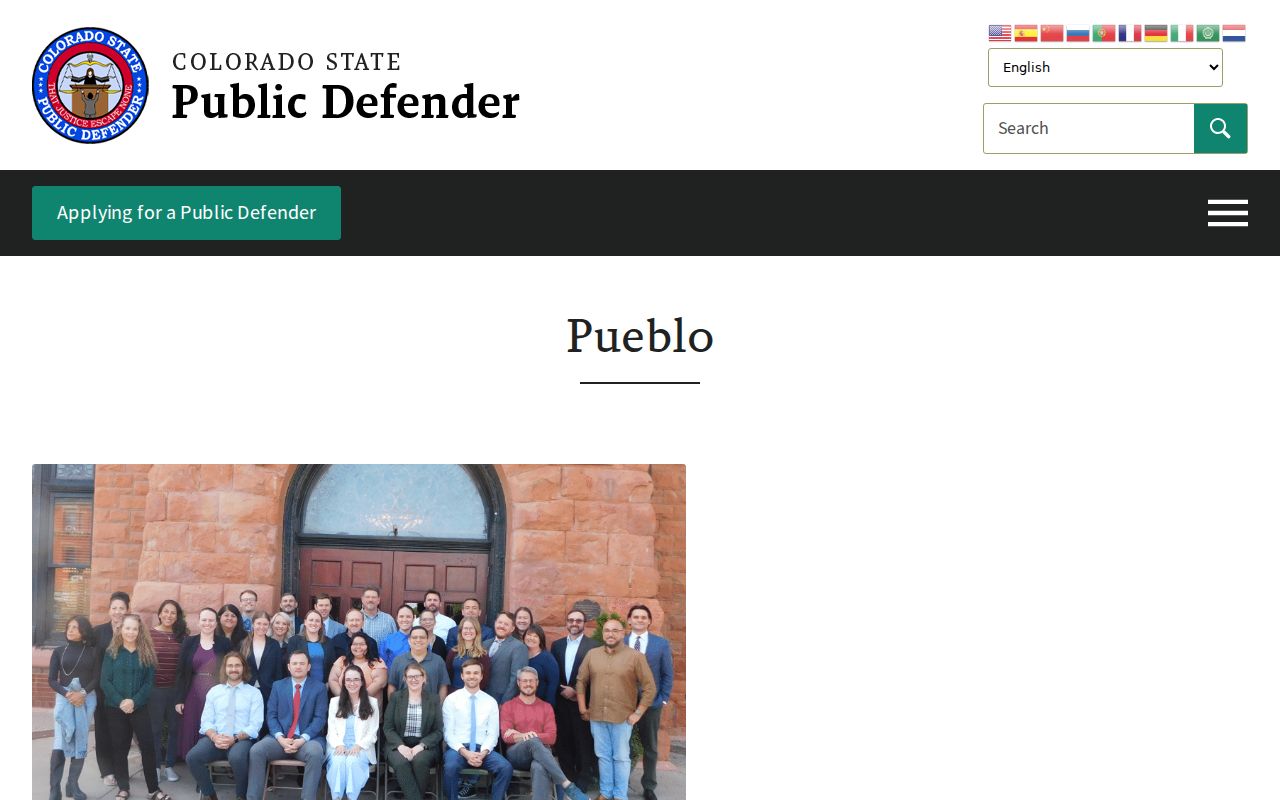
The image helps separate counsel from the clerk. Requests for filed pleadings, orders, judgments, and certified outcomes go to the court that holds the case.
Likewise, a transcript, clerk file, police report, and CBI criminal history are four different products. Transcript requests may be delivered in person or emailed to 10CourtReporter@judicial.state.co.us. A police narrative comes from the arresting agency. CBI supplies a statewide fingerprint-supported history, not the full court file.
Missing Pueblo Criminal Case Results
If the docket returns nothing, retry the name with the correct spelling and check another filing year. Search by case number when one appears on a citation, bond paper, or booking entry. Then check Pueblo Municipal Court if the event occurred in the city. A delay can occur between arrest and filing, and the filed counts may differ from booking labels.
When those steps fail, ask the arresting agency whether the matter was declined, filed under another number, sent to another jurisdiction, or remains under review. The clerk can explain its search process, but sealed or suppressed records may not be available. Do not treat a blank public search as proof that no arrest, filing, or restricted case exists.
Pueblo Case Access Restrictions
Colorado court files are generally open subject to court rules, statutes, and orders. The Colorado Criminal Justice Records Act also governs criminal justice agencies, but a court docket and a discretionary police narrative are not the same type of record. Juvenile information, victim details, personal identifiers, medical material, protected addresses, investigative content, and sealed documents may be withheld or redacted.
Pueblo Combined Court operates Monday through Friday from 8:00 a.m. to 4:00 p.m., except state holidays. Visitors should carry photo identification and expect security screening. Self-help can be reached at 719-404-8752 during its posted weekday schedule. The courthouse also provides interpreter and ADA channels, so identify language or accommodation needs before a visit.
When access is denied, ask for the legal basis and narrow an overbroad request to a case number, date range, and named document. For the path from booking allegations to filed counts, the fuller Pueblo County arrest history discussion keeps jail and court records in their proper roles.
Remote access and counter access also serve different needs. The public docket is useful for finding a scheduled event and capturing a case number. A clerk request is needed for filed papers, older or off-site material, and certified copies. The municipal clerk must be contacted on its own for city cases. Before paying for copies, name the exact order, disposition, or date range needed and ask whether any part is restricted. That approach limits cost while preserving the record most useful for self-review or correcting an incomplete statewide entry.